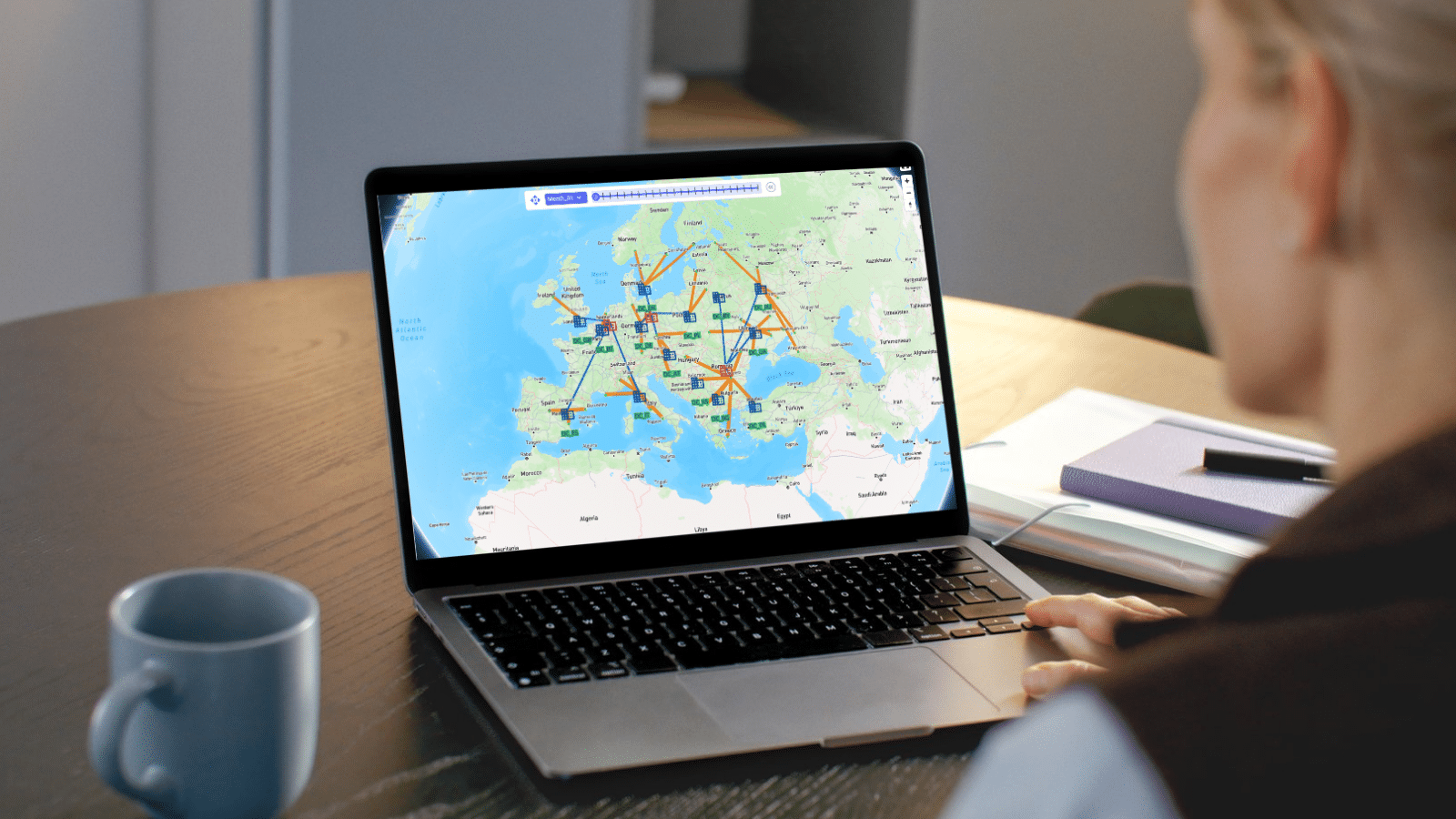
Optilogic Training Courses teach teams to model, analyze, and optimize supply chains with confidence. Learn Cosmic Frog and DataStar through expert-led, hands-on sessions that deliver faster insights, stronger decisions, and measurable ROI.



Explore Optilogic’s on-demand training library, curated to help you learn exactly what you need, when you need it. Access everything at your fingertips and move through each module at your own pace.
In this session, Neeru Bhopal from Optilogic's Product Management team introduces Ada, Optilogic's agentic AI built specifically for supply chain design, and shows what it looks like to go from raw, messy data to a board-ready analysis in a single session instead of twelve weeks.
This is the follow-up session for anyone ready to move past the demo and actually build with Ada. Ryan Purcell, Pranjal Ranjan, and Nicha Sangiampornpanit walk through live, hands-on exercises using a real historic shipments dataset — the same data you can copy into your own account and follow along with.
Please try different keywords.
This chapter tackles one of the most common hurdles in supply chain modeling: infeasibility. You’ll see how Cosmic Frog flags errors when your model can’t satisfy all its constraints, and more importantly, how to track down the root cause. Starting with the validation report, you’ll learn how to spot critical errors, trace them back through sourcing or transportation policies, and fix the issues step by step.
In this episode, the team explores Maps, the interactive visualization tool in Cosmic Frog that brings your supply chain to life. Instead of sifting through spreadsheets, you can layer facilities, customers, and flows onto a visual map, style them for clarity, and compare scenarios side by side. Want to see how closing a distribution center impacts your network? Just toggle between scenarios on the map, and watch the flows shift in real time—making it easier to spot patterns, communicate insights, and make data-driven decisions.
In this episode, the team introduces Leapfrog, a large language model embedded directly in Cosmic Frog. Instead of writing queries or navigating complex interfaces, you simply ask questions in plain English. Want to compare costs between scenarios? Just type it out, and LeapFrog translates your words into SQL, runs the query, and serves up the results.
This session explores the automatic OptiRisk metrics available with each Cosmic Frog scenario. We dig into the components that make up each scenario's risk scores, where to find this reporting within Cosmic Frog outputs, and dashboards available to visualize cost versus risk tradeoffs. We then walk through examples of building and tuning your own risk profiles, and how to respond to risk identified with mitigation scenarios and quantifying impacts of risk events.
Please try different keywords.
Ready to take your modeling skills to the next level? Join Leapfrog 102 for a hands-on walk-through of the latest AI-powered use cases—designed to help you explore, edit, and optimize like a pro inside Cosmic Frog.
Please try different keywords.
This session will give users and introduction to the Hopper engine. Typical Hopper use cases, differences and synergies with other Optilogic engines, and high level solve approach will be covered. The session will also equip users with the base input information needed for models, as well as types of outputs.
This session examines the inputs for an outbound multi stop routing model within Cosmic Frog. Base elements, pickup and delivery constraints, assets, costs and time considerations will be covered.
This session covers Hopper scenarios that consider tradeoffs between reatining current route configurations and customer segmentation vs. relaxation of these rules.
This session covers Hopper scenarios that considers the impact of adjusting various factors when routing outbound shipments. Considerations include business hours, asset types available, and origin locations for the shipments.
Please try different keywords.
Understand the conceptual elements of simulation modeling, what makes simulation unique as a modeling methodology, and questions that can be addressed with simulation.
Learn the foundational elements of building supply chain simulation models in Cosmic Frog, including Model Elements, Transportation, Sourcing, Production, Inventory, and Demand (Orders).
Step-by-step instruction to be able to confidently run your own simulation model and review outputs.
Please try different keywords.
In this session, we introduce the fundamentals of NEO optimization models in Cosmic Frog. You'll learn how NEO evaluates millions of possible supply chain configurations to find the least-cost or most profitable way to meet customer demand while respecting every constraint in your network. Instead of manually analyzing trade-offs, NEO automatically determines the optimal combination of suppliers, manufacturing sites, and distribution centers to fulfill orders.
In this episode, we explore two powerful pre-run validation tools in Cosmic Frog: the Model Assistant and the Integrity Checker. Instead of running your entire model, waiting for results, and then diagnosing issues, you can catch data errors in just minutes before hitting "run." The Model Assistant flags missing essential information—like un-geocoded locations or absent production policies—while the Integrity Checker goes deeper, identifying numeric issues, unit of measure mismatches, master data references that don't exist, and data type conflicts.
In this episode, we dive into scenario building in Cosmic Frog—the heart of network optimization testing. Instead of manually reconfiguring your entire model for each "what if" analysis, you create modular scenario items that make specific changes to your data. Want to test closing a facility? Doubling demand for a customer? Removing flow constraints to see optimal behavior? Just build a scenario item, assign it to a scenario, and run. Each scenario can combine multiple items, letting you stack changes and test complex configurations in minutes.
In this episode, we explore how to analyze your optimization results through Cosmic Frog's output tables. Instead of digging through raw solver logs or exporting data to external tools, you can filter, compare, and aggregate results directly within Cosmic Frog. Want to see total cost savings between your baseline and optimized scenarios? Need granular detail on which facilities are shipping to which customers? And it doesn't stop there. You'll see how to use the job logs and error logs to troubleshoot model runs, validate that scenarios completed successfully, and identify where infeasibilities occur. With Cosmic Frog's output tools, analysts can quickly validate results, pinpoint where savings are generated, and confidently present findings to stakeholders.
Please try different keywords.
How do you give healthcare supply chain leaders in low- and middle-income countries the same design and optimization power that big companies take for granted? In this short interview, Taylor Wilkerson of Design for Life — a nonprofit focused on improving healthcare supply chains — explains how access to the right tools lets leaders test changes in a sandbox before committing to them in the real world. Taylor shares why Design for Life has partnered with Optilogic since 2023, how Cosmic Frog's optimization capabilities go far beyond what's possible in a spreadsheet, and why Ada's shift from operations-research modeling to natural-language questions has him especially excited about what comes next for the partnership — and for the healthcare supply chains it supports.
Most leaders underestimate two cost drivers hiding in plain sight — and both can run into tens of millions of dollars a year. In this short interview, Nate Rosier of enVista breaks down why getting the right inventory to the right place at the right time, and hitting delivery time windows, matter far more than most P&Ls give them credit for. Nate explains why these costs stay invisible: vendor costs live in cost of goods sold, supply chain costs sit in a different bucket entirely, and nobody's connecting the dots between them. Hear why he sees that end-to-end, cause-and-effect view — across SKUs, vendors, and silos — as exactly where Optilogic delivers the most value.
Every leading software company today has to figure out how AI fits into what they do — but the companies that win aren't just adding AI, they're using it to unlock genuinely new ways to compete. In this short interview, investor Mark Koulogeorge of MK Capitol explains why he sees Optilogic sitting right at that intersection. Mark breaks down why supply chain technology is such a powerful lever — lower costs free up investment elsewhere, faster response times unlock revenue opportunities faster — and why building the right platform takes more than good technology. It takes a team that's lived the customer's problem for decades and paired that depth with real commitment to innovation. Hear why he believes that combination is exactly what sets Optilogic apart.
Building a five-year capacity plan is one thing — building one that actually holds up as your business evolves is another. In this customer spotlight, a supply chain leader at Cencora shares how the company approached a critical question: where does our distribution network need to be in five years, and where are the gaps today? Hear how Cencora connected its long-term capacity planning directly to business strategy, using advanced analytics and simulation to understand throughput and storage needs across its network — and why partnering with Optilogic became central to turning that five-year plan from a North Star into an executable roadmap.
Most companies try to solve supply chain problems by stacking systems on top of each other — a planning system here, an MRP system there, manufacturing excellence bolted on somewhere else. In this short interview, Akshay Singh of Bain & Company explains why that approach keeps falling short, and what it actually takes to get connected decisions instead of conflicting ones. Akshay makes the case for treating procurement, inventory management, and warehousing as decisions that live together in one space, rather than solving them one system at a time — and shares why the customizability of the Optilogic platform, from building your own algorithms to your own apps, has been key to delivering results for Bain's clients.
How do you promise 30-minute delivery in a country where 45% of the population sits beyond the reach of trucks and highways? In this customer spotlight, Felipe Moraes of Amazon Brazil breaks down the infrastructure challenges — railways, sea and river routes, and dense favela communities — that make Brazil's logistics network far more complex than most. Hear how Amazon Brazil transformed its network from two-day delivery to a sub-30-minute standard, and why having a fast-moving, insight-driven partner was essential to making that shift possible. Felipe shares what it's meant to work with Optilogic — from near real-time visibility into network performance to the speed of turning data into decisions — and why he calls it a game-changer for the future of their business.
Please try different keywords.
Visit our Help Center to explore detailed product guides, troubleshooting tips, and expert insights from the Optilogic community. Whether you’re learning the basics or diving into advanced modeling, you’ll find step-by-step resources to help you get the most out of the Design Intelligence Platform.
Explore all Optilogic resources in one place — from expert-led webinars and thought leadership blogs to customer success stories and product videos.
See how Optilogic combines advanced modeling, risk analysis, and expert support to deliver faster decisions and measurable supply chain results.